
Banks, ravines and swales
Slope Stabilization & Erosion Control in Albany, NY
Mulch, matrix and blankets that hold soil on a slope until roots take over.
- No-charge yard walk-through, then an estimate in writing
- Seed mixes picked for sand, silt or clay soil
- Watering plan handed over with every new lawn
Keeping Soil on the Slope
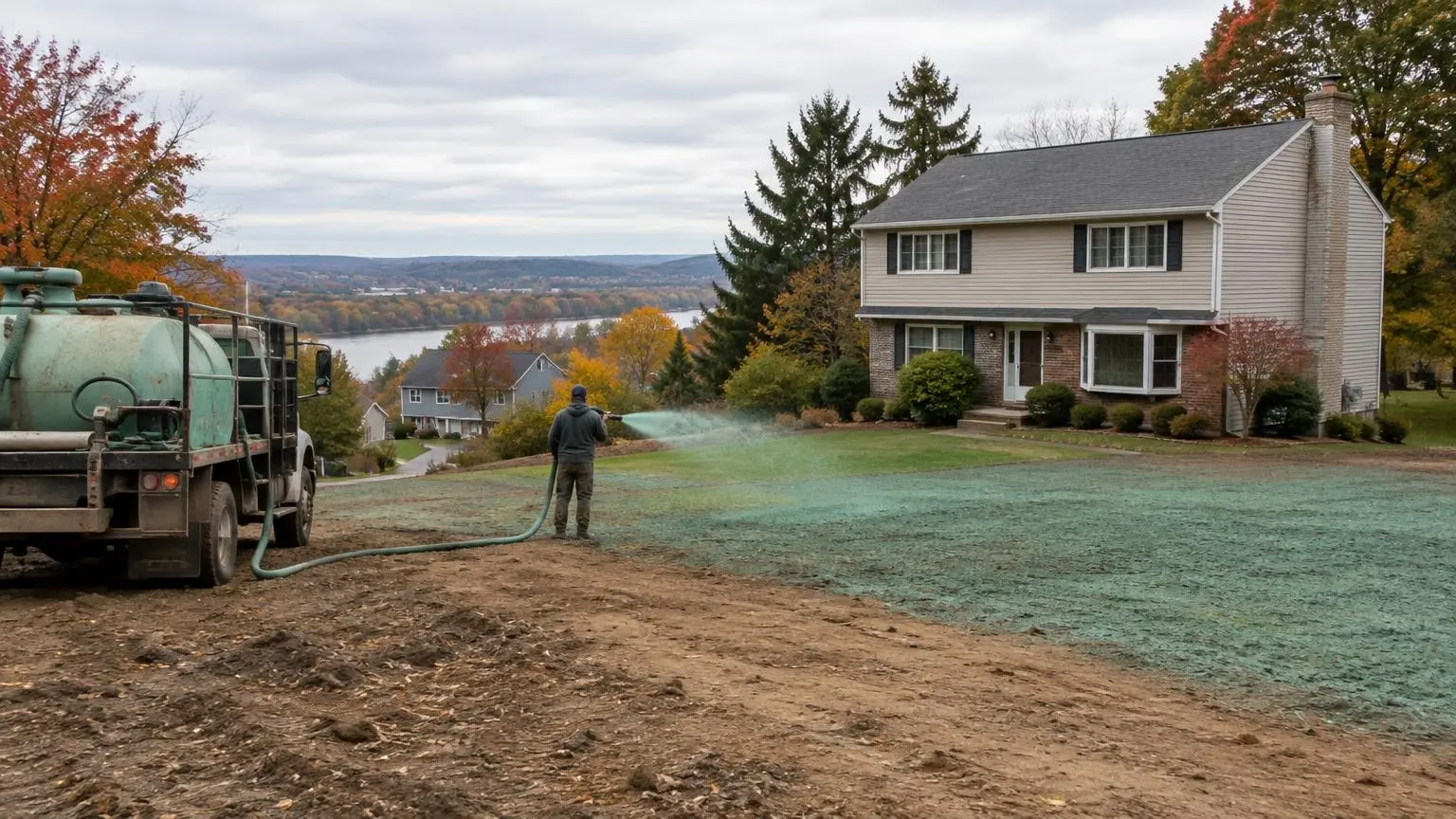
Slope stabilization and erosion control in Albany is about holding soil in place long enough for plants to anchor it. A bare bank behind a house, a ravine edge, a drainage swale or a road ditch will lose soil with every heavy rain until something covers it. We use hydro mulching, bonded fiber matrix and erosion control blankets, usually with seed sprayed in or underneath, to protect that ground and get vegetation established. Homeowners call us about one washed-out bank; builders and towns call about long runs of ditch and basin slope.
Why Capital District slopes move
The region's terrain was built by glacial water. The city of Albany runs from 378 feet near the Loudonville Reservoir down to about 2 feet above sea level at the Hudson, and the towns around it are cut by creeks, ravines and bluffs. Much of that ground is glacial lake sediment. The USDA describes Hudson series soils, found throughout the Mohawk and Hudson valleys, on slopes from 0 up to 60 percent, and notes that more sloping and dissected areas show evidence of slumping or mass slipping. The same soils have medium to very high runoff potential, so rain runs off the surface rather than soaking in. A bank like that does not hold seed on its own.
Choosing the right cover
- Hydromulch is wood or paper fiber sprayed with seed and tackifier. It works on gentle slopes and large flat areas and is the cheapest cover per square foot.
- Bonded fiber matrix (BFM) is a heavier hydraulic mulch with stronger binders that cures into a single unbroken layer. It is used on steeper banks where plain hydromulch would slide or rill.
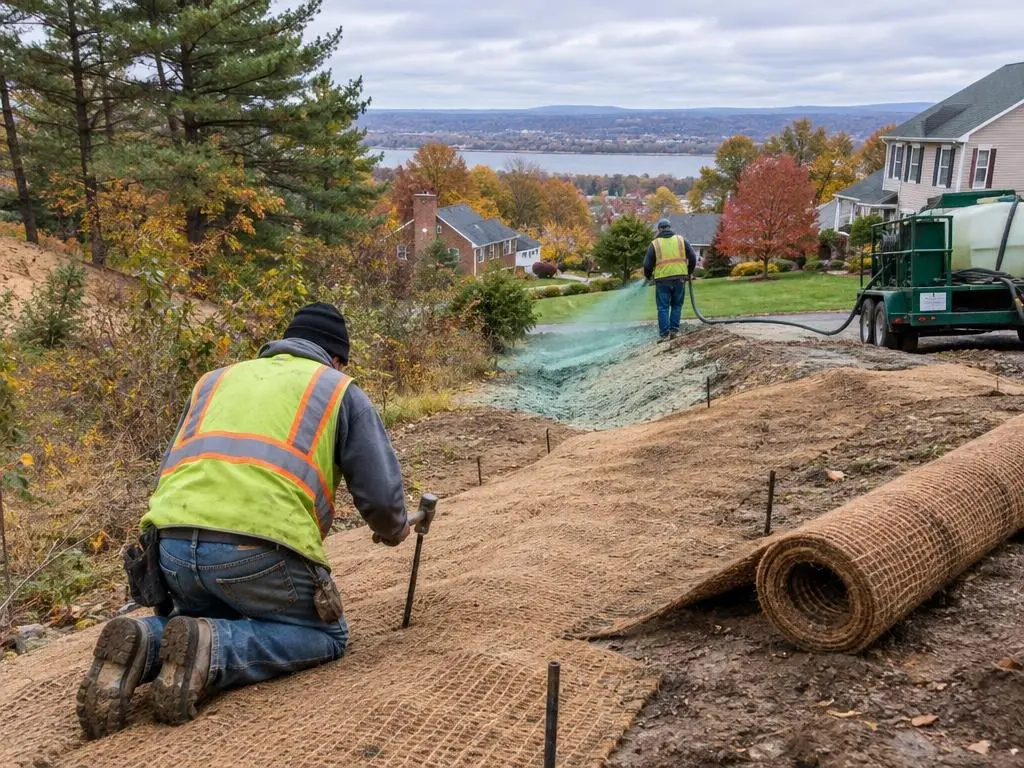
- Erosion control blankets come on rolls and are stapled down to the slope. They are made from straw, a straw and coconut fiber blend, or coconut (coir) alone. Straw blankets suit short-term protection on moderate slopes; coir lasts longer and handles steeper ground and channel flow.
The right choice depends on slope steepness, length, soil and whether water concentrates in a channel.
Who calls us
Homeowners with a bank behind the house that sheds soil onto the patio every spring. Builders with steep lot edges or basin slopes that inspectors keep flagging. Towns and property managers with drainage ditches that are cutting deeper every year. Each needs something slightly different, and as erosion control contractors we size the fix to the problem rather than putting the heaviest product on every slope.
Swales, ditches and channels
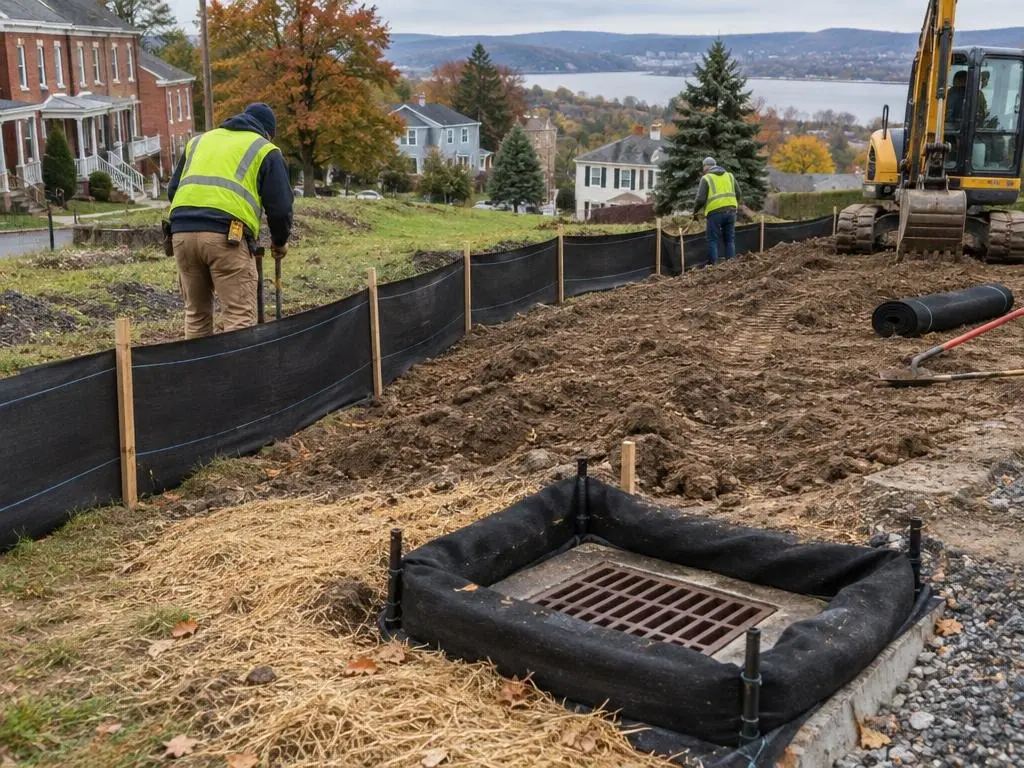
Where water collects and flows, a slope problem becomes a channel problem. Grass-lined swales and roadside ditches need protection that resists flowing water, not just raindrops. We line those with blankets keyed into trenches at the top and stapled on a tight pattern, then seed through or under them. On longer ditch runs, check structures or rock may be needed; we will say so if the job calls for it.
Timing around Albany weather
July is the wettest month at Albany's airport, averaging about 4.55 inches, and thunderstorms in summer can put a lot of that down at once. Spring snowmelt from a typical 59-inch snow season is the other big erosion event of the year. We prefer to have slopes covered before both. If a slope is finished late in fall, blankets or BFM can protect it through winter even if the grass does not germinate until spring. Get a free estimate
Sandy banks versus clay banks
On the sandy old lake deposits of the Pine Bush side of the region, slopes ravel and dry out; seed needs mulch to hold moisture and a tackifier so wind does not move it. On clay soils, the surface seals, water sheets off, and small rills grow into gullies. Clay slopes benefit from roughening the surface across the slope before seeding so water slows and seed has places to lodge. Either way, the top of the slope matters: water coming over the crest from a roof, driveway or lawn has to be dealt with, or no cover will hold.
Straw blankets in practice
Straw blankets are the workhorse for residential banks: they cover quickly, hold seed and soil through the first season, and break down as the grass takes over. They have to be installed correctly to work. The top edge is buried in a trench at the crest so water cannot run under it, rolls are overlapped shingle-style downhill, and staples go in on the pattern the manufacturer calls for, tighter on steeper ground. Loose blankets that water can get under do more harm than good, because the water tunnels beneath them and carries soil away out of sight.
When to call an engineer
Erosion control contractors can stabilize the surface of a slope. We cannot fix a slope that is actually sliding deep below the surface, a failing retaining wall, or a bank undercut by a creek. If we see signs of a deeper problem, like cracks at the top, bulging at the toe or leaning trees, we will recommend a geotechnical engineer before any seed goes down.
Erosion Control Options
What we use, and where each one fits.
Hydromulch with seed
Wood or paper fiber mulch and seed sprayed together on gentle slopes and large areas.
Bonded fiber matrix
Heavier hydraulic mulch with strong binders for steeper banks.
Straw erosion control blankets
Short-term protection for moderate slopes while grass establishes.
Straw-coconut and coir blankets
Longer-lasting mats for steeper slopes, swales and channel linings.
Swale and ditch lining
Blankets trenched in and stapled where water flows, with seed underneath.
Winter slope protection
Blankets or matrix to hold a late-season slope until spring seeding.
Published Erosion Control Rates
| Work | Published range (source) |
|---|---|
| 2025 highway erosion unit rates: sprayed wood-fiber mulch, per 1,000 sq ft | $98 |
| Same list: straw mulch spread dry by hand, per 1,000 sq ft | $170 |
| Same list: straw-coconut blanket (70% straw, 30% coconut), per 1,000 sq ft | $468 |
| Same list: 100% coir blanket, per 1,000 sq ft | $532 |
| Steep slope add-on for residential hydroseeding, per sq ft (HomeGuide) | $0.05 to $0.10 |
| Bonded fiber matrix | Quoted once we have walked the slope |
The 2025 highway erosion unit rates are contract figures published outside New York and are not Albany quotes. Slope length and steepness, access and material shift the cost. For budgeting only. The amount in our written proposal is what is billed.
Stabilizing a Slope
1. Look at the whole slope
Steepness, length, soil, where water comes from and where it goes.
2. Fix the water first
Redirect roof, driveway or lawn runoff away from the crest where possible.
3. Prepare the surface
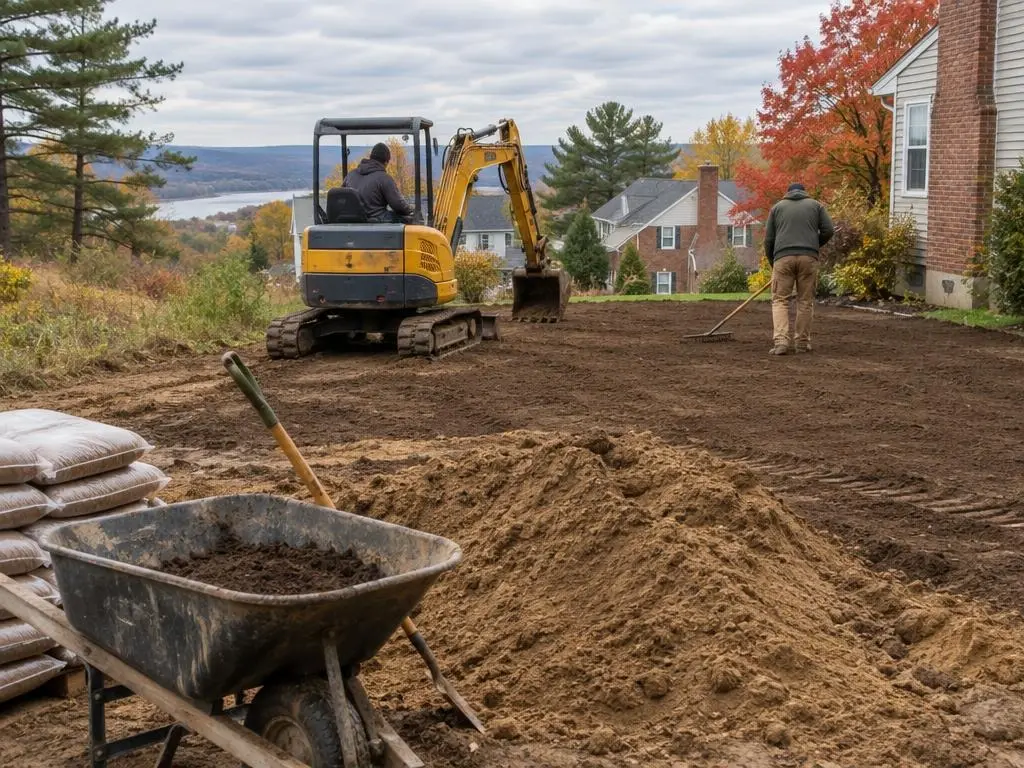
Fill rills, roughen across the slope and add topsoil where needed.
4. Seed and cover
Hydromulch, matrix or blankets installed to suit the slope.
5. Check after storms
We look at it after the first big rain and repair any weak spots.
Why Choose Us for Slope Stabilization & Erosion Control
Right cover for the slope
We match hydromulch, matrix or blankets to steepness and flow, not habit.
Water handled at the top
We look at what is running over the crest before covering the face.
Honest limits
Deep slope failures get an engineer, not more seed.
Slope Stabilization & Erosion Control Questions
Hydromulch or bonded fiber matrix: which one does an Albany bank need?
Both are sprayed. Hydromulch is lighter and suits gentle slopes. Bonded fiber matrix uses stronger binders and cures into one unbroken layer that holds on steeper banks.
Will the blankets have to be pulled up once the grass comes in?
Normally not. Straw and coir blankets are designed to rot away gradually while the grass grows up through them, so we leave them where they are. Before installing, we go over which blanket and netting suit your slope.
How steep is too steep for hydroseed alone?
It depends on soil and slope length, but once a bank gets steep enough that water starts cutting rills, we add matrix or blankets. We decide that on site.
Can you stop a creek from eating my backyard?
We can stabilize the upper bank surface. Work at the water's edge may need permits and a different design, so we will tell you if it is beyond seeding and blankets.
Slope Stabilization & Erosion Control Service Areas
- Hydroseeding in Albany, NY
- Hydroseeding in Colonie, NY
- Hydroseeding in Guilderland, NY
- Hydroseeding in Bethlehem, NY
- Hydroseeding in Clifton Park, NY
- Hydroseeding in Halfmoon, NY
- Hydroseeding in Malta, NY
- Hydroseeding in Saratoga Springs, NY
- Hydroseeding in Schenectady, NY
- Hydroseeding in Troy, NY
- Hydroseeding in Niskayuna, NY
- Hydroseeding in Glenville, NY
- Hydroseeding in Rotterdam, NY
- Hydroseeding in East Greenbush, NY
- Hydroseeding in North Greenbush, NY
- Hydroseeding in Brunswick, NY
- Hydroseeding in Ballston, NY
- Hydroseeding in Wilton, NY
- Hydroseeding in Cohoes, NY
- Hydroseeding in Waterford, NY
- Hydroseeding in Stillwater, NY
- Hydroseeding in Schodack, NY
- Hydroseeding in New Scotland, NY
- Hydroseeding in Rensselaer, NY
Get a Slope Stabilization & Erosion Control Estimate
Free slope assessments around Albany and the Capital District.