
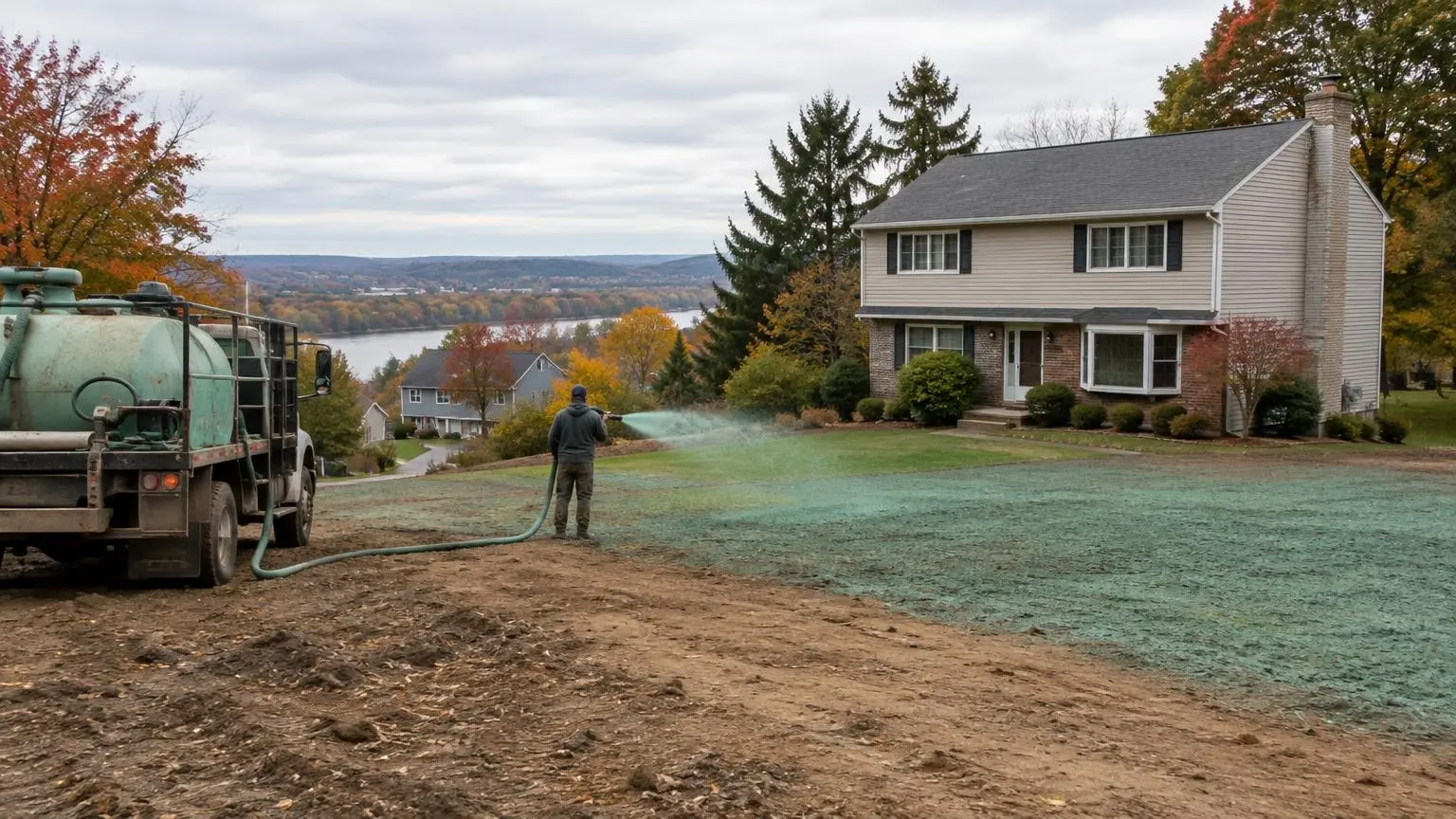
Sediment control for active sites
Silt Fence & Inlet Protection in Albany, NY
Perimeter fence and storm drain protection set up right, kept up, and taken down when the grass is in.
- No-charge yard walk-through, then an estimate in writing
- Seed mixes picked for sand, silt or clay soil
- Watering plan handed over with every new lawn
Keeping Mud Out of the Street
Silt fence and inlet protection in Albany keep sediment from a construction site out of the street, the neighbor's yard and the storm drain. Silt fence is a woven or nonwoven fabric trenched into the ground along the downhill edge of a disturbed area, so runoff slows and drops its soil behind the fence. Inlet protection goes around or inside storm drain grates so muddy water is filtered before it enters the pipe. Builders, excavators, pool installers and homeowners doing additions all use them, and many permits require them before any soil is moved.
What the rules say
Under federal Clean Water Act rules, construction disturbing an acre or more needs a stormwater permit, and so do smaller sites within a bigger planned development. Each of those permits obliges the operator to design, put in and keep up erosion and sediment controls that work. Silt fence and inlet protection are the most common of those controls. Smaller jobs may still need them under a town building permit, especially near a stream, wetland or storm drain. Your engineer, builder or building department sets the requirement; we install to the plan.
Why storm drains matter here
Rain that falls on a construction site picks up loose soil and carries it to storm sewers and then into rivers and streams. In Albany several old creeks, including Foxes Creek, the Beaver Kill and the Rutten Kill, were diverted underground in the 19th century, and the Hudson below the city is still a tidal estuary. Mud that gets into a catch basin ends up in pipes that are expensive to clean and in water that everyone downstream shares. Inlet protection on the drains nearest your site is cheap insurance against both.
Where fence goes on a typical lot
On a single house lot, silt fence usually runs along the downhill property lines and around the topsoil stockpile, with gaps only where the driveway entrance is stabilized. On a sloped lot we may add a second row partway down so water slows before it reaches the perimeter. We place it a few feet out from the toe of the slope where we can, so there is room for sediment to collect without spilling over.
Installing it so it works
Silt fence fails most often because it is installed badly. If the lower edge of the fabric is only laid on the ground or pinned instead of buried in a trench, water runs straight underneath. Stakes go on the downhill side. The line follows the contour, and both ends bend uphill so water cannot slip around them. Where water concentrates, like a swale or a low corner, silt fence alone will be overwhelmed, and a different control is needed. We trench our silt fence installation in, set stakes at the right spacing, and switch to wire-reinforced or stabilized fence where heavier loads are expected. Get a free estimate
Sand and clay sites
On sandy Pine Bush ground, the trench is easy to dig but the backfill has to be compacted well or it washes out. On clay sites, like those on Hudson series soils with medium to very high runoff potential, more water reaches the fence faster and the fabric clogs with fine silt sooner. Clay sites usually need more frequent cleanout and sometimes a second row.
Common mistakes we see
Fence run straight down a slope instead of across it, so water runs along it and out the end. Fence with no trench, flapping in the wind with mud washing under it. A single long line across a big slope, with nothing to slow water before it hits the fence. Fence that was never cleaned out and is buried to the top in sediment. Inlet filters that have clogged and are now flooding the street. Fixing any one of these is usually a quick job; leaving them can mean a stop-work order or a cleanup bill.
Maintenance and removal
Silt fence is not a set-and-forget item. After significant rain, sediment builds up behind it, fabric tears, and stakes lean. A fence that is half full of sediment no longer works. We offer inspection and cleanout visits, repair damaged sections, and replace inlet filters that have clogged. Once grass has taken hold, we take the fence out, rake the old trench smooth and seed over it, so you are not left with a strip of bare dirt where the fence was.
Who we work for
We work with home builders, excavation and septic contractors, pool installers and homeowners doing their own additions or garages. As silt fence contractors who also hydroseed, we can set your perimeter controls at the start of the job and finish the site with seed at the end, which keeps one crew accountable for the ground from start to finish. For multi-phase subdivisions we can keep a running schedule of fence moves as phases open and close, so controls stay where the bare ground actually is.
Sediment Control Services
Controls we install, maintain and remove.
Perimeter silt fence
Trenched-in fabric fence along the downhill edges of a disturbed area.
Stabilized or wire-backed fence
Stronger fence for longer slopes and heavier runoff.
Inlet protection
Filter barriers, bags or gravel and mesh around storm drain inlets.
Stockpile protection
Fence around topsoil and fill piles so they do not wash away.
Inspection and cleanout
Sediment removed and torn or leaning sections repaired after storms.
Removal and restoration
Fence pulled and the trench line graded and seeded at the end of the job.

Published Sediment Control Rates
| Work | Published range (source) |
|---|---|
| Plain silt fence without stabilizing, each 100 ft (2025 highway erosion unit rates) | $378 |
| Silt fence, stabilized type, per 100 ft (same list) | $748 |
| Storm drain inlet guard made of silt fence, per inlet (same list) | $102 |
| Straw bale inlet guard, per inlet (same list) | $135 |
| Gravel-and-mesh inlet guard, per inlet (same list) | $172 |
| Stabilized construction entrance | Quoted after we see the entrance location |
The 2025 highway erosion unit rates were published for contracts outside New York, so treat them as reference points, not Albany quotes. Fence length, terrain, access and the number of maintenance visits move the cost. For budgeting only. The amount in our written proposal is what is billed.
From Layout to Removal
1. Review the plan
We go over your erosion control plan or permit and walk the site.
2. Lay out the line
Fence placed along contours at the downhill edges, with ends turned up.
3. Trench and install
Fabric buried, backfilled and compacted, stakes set on the downhill side.
4. Protect inlets
Filters or barriers on nearby storm drains.
5. Maintain and remove
Cleanouts after storms, then removal and seeding once the site is stabilized.

Why Choose Us for Silt Fence & Inlet Protection
Trenched, not pinned
The fabric is buried so water cannot run under it.
One crew start to finish
We set the fence and come back to seed the site.
Cleanout visits available
We keep the fence working, not just standing.
Silt Fence & Inlet Protection Questions
Will my Albany house addition need silt fence?
It depends on your town and how close you are to a stream, wetland or storm drain. Check your building permit; many towns require it even on small jobs.
On an Albany job, when does the silt fence come down?
Until the disturbed area is stabilized, usually with established grass. Then it should be removed and the trench line seeded.
Why does silt fence fall over?
Usually because it is full of sediment, the stakes were on the wrong side, or it was never trenched in. Regular cleanout prevents most failures.
What is inlet protection?
It is a filter or barrier at a storm drain that catches sediment before muddy water enters the pipe.
Silt Fence & Inlet Protection Service Areas
- Hydroseeding in Albany, NY
- Hydroseeding in Colonie, NY
- Hydroseeding in Guilderland, NY
- Hydroseeding in Bethlehem, NY
- Hydroseeding in Clifton Park, NY
- Hydroseeding in Halfmoon, NY
- Hydroseeding in Malta, NY
- Hydroseeding in Saratoga Springs, NY
- Hydroseeding in Schenectady, NY
- Hydroseeding in Troy, NY
- Hydroseeding in Niskayuna, NY
- Hydroseeding in Glenville, NY
- Hydroseeding in Rotterdam, NY
- Hydroseeding in East Greenbush, NY
- Hydroseeding in North Greenbush, NY
- Hydroseeding in Brunswick, NY
- Hydroseeding in Ballston, NY
- Hydroseeding in Wilton, NY
- Hydroseeding in Cohoes, NY
- Hydroseeding in Waterford, NY
- Hydroseeding in Stillwater, NY
- Hydroseeding in Schodack, NY
- Hydroseeding in New Scotland, NY
- Hydroseeding in Rensselaer, NY
Get a Silt Fence & Inlet Protection Estimate
Silt fence and inlet protection set up on your schedule.